
Upload a script
To upload a script from the All Devices view Settings > Script Manager option, you must be signed into N-sight RMM as a user with enhanced privileges, for example a Superuser or (non-Classic) Administrator level account, or with a login with the required Custom Scripts permissions enabled or the Agent Key (where access is enabled).
- In the All Devices view, go to Settings > Script Manager.
- Select New.
- Enter the script details in the Add User Defined Scripts dialog:
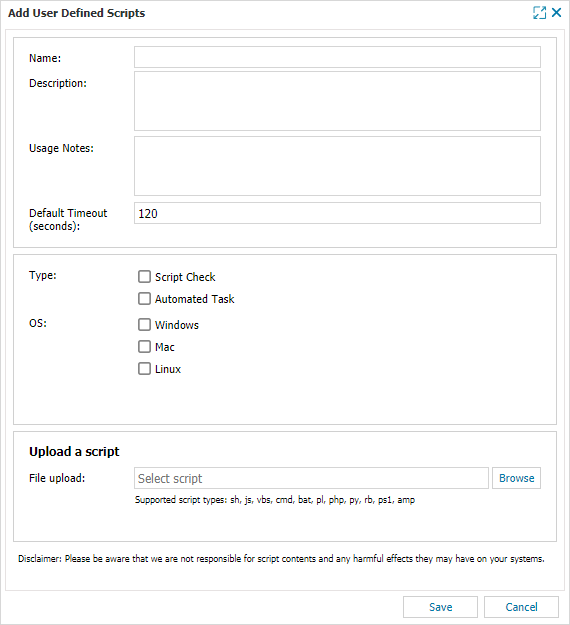
- Name: A descriptive name to identify the script in the All Devices view and reports.
- Description: The purpose of the script.
- Usage Notes: Information shown in the Test Parameters section when you add or edit a Script Check or Automated Task. Include details about the script’s function or examples of command-line parameters to help users configure the script correctly.
- Default Timeout: The time in seconds after which the Agent stops the script and reports it as failed.
- Type: Choose whether the script runs as a Script Check or an Automated Task.
Automated Tasks are supported for Windows, Mac (from Agent 2.3.0), and Linux (from Agent 2).
- OS: The operating system the script is designed for. The script will only be available for devices running that OS.
The Mac Agent and Linux Agent support Shell scripts and interpreted languages such as Perl, PHP, Python, Ruby for which there is a handler installed.
- Browse to the script location.
- Maximum script size: 65,535 characters
- Maximum script output size: 10,000 characters
- Select Save to upload the script.
Script guidelines
- The Mac Agent and Linux Agent support shell scripts and interpreted languages such as Perl, PHP, Python, Ruby, provided the handler installed.
- To help a shell script run successfully, declare the Bash interpreter at the beginning of the script: #!/bin/bash
#!/bin/bash
"Hello world"
exit 0
Script argument handling (Windows)
For the Windows Agent, script arguments entered in the Script Parameters, Command Line field of the custom Script Check and Automated Task dialog are passed to the script exactly as they would be if entered directly on the device itself.
What do you want to do?
- View the supported script types
- Check the requirements for returning Script results to the UI
- Determine whether the end user can interact with the script
- Parse Command Line Arguments to the script
- Deploy the Script on one of more devices
- Learn about the Windows Automation Manager
- View script Troubleshooting suggestions
- Read our scripting FAQs