
Configure the Server Weekly Report Email Templates
The Client Server Weekly Report provides information on the performance of the Client's server during the previous week. Depending on the status of the servers, a "no problems found" or a "problems found" report email is sent. You can configure the email templates to match your requirements.
A Problems found email is sent when one or more Checks fail, or information for a day's Daily Safety Check is not received.
Configure the email templates for the client daily and weekly reports and the Executive Summary Report before enabling email delivery to clients.
Make a copy of the default template before editing.
Configure the Server Weekly Daily Reports Mail Templates
-
In the All Devices view, go to Mail Templates > Client Reports > Server Monitoring > Server Client Weekly Report - No Problems Found or Server Client Weekly Report - Problems Found.
- Enter the From address the Reports are to come from. We recommend you use the format, Descriptive Name <Email Address>, to ensure acceptance by all email clients.
If you use a custom From address in a mail template, make sure the address exists. If it does not exist, sender verification may fail. The default mail server for the From address is: alert@remote.management.
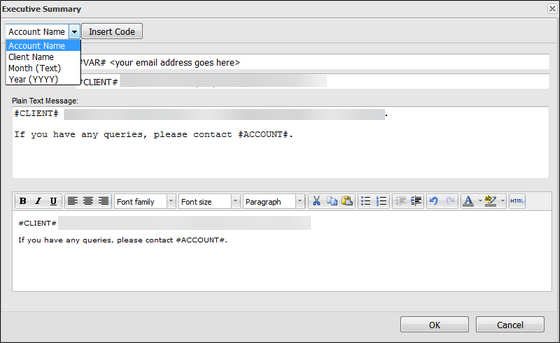
- Enter the information for the Subject line, Plain Text Message, and HTML Text message.
All content changes must be applied to both the Plain Text Message and the HTML versions.
- Click OK to save.
You can use substitution strings in the email template. See the Substitution String information below or see Mail template substitution strings.
HTML Body Editor
When you edit the body of the email, you can change both the Plain Text and HTML versions. For greater flexibility, when you configure the HTML version of the template there is a visual WYSIWYG (What You See Is What You Get) and an HTML Source editor.
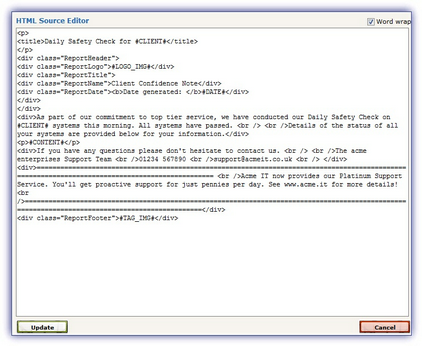
To use the HTML Source Editor:
- Click the HTML button above the HTML body.
- Edit the HTML in the HTML Source Editor.
- Click Update to save and return to the Mail Template dialog.
- Review the HTML changes in the WYSIWYG editor.
- After making any further changes click OK to save the template.
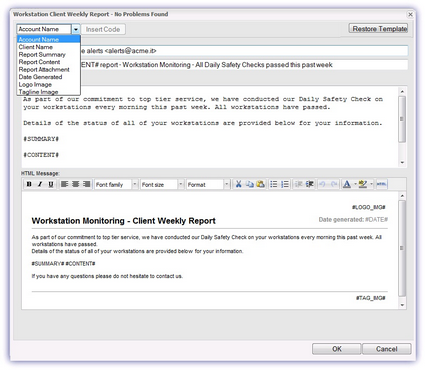
Substitution strings (Wildcards)
Substitution strings replace placeholders (wildcards) in a template with values from the database. This lets you personalize messages with client details and other information.
Templates support substitution strings in their From address, Subject line and Body (both text and HTML).
Add substitutions strings to a template
- In the template, select where to add the string: From address, Subject line, or Body.
- Choose a substitution string from the dropdown list. Only supported strings for that field are shown.
- Select Insert Code to add the string.
- Select OK to save the template.
If you add substitution strings in the template body, insert the string in the plain text and the HTML versions of the message.
The following substitution strings are available in the Server Client Daily/Weekly Report mail templates.
| Variable | Substitution String | Supported in From address? | Supported in Subject line? | Supported in Body? | Note | Example |
|---|---|---|---|---|---|---|
| Account Name | #ACCOUNT# | Yes | Yes | Yes | MSP Name | My MSP Dashboard
|
| Client Name | #CLIENT# | Yes | Yes | Yes | Client Name | Abertay Pharmaceuticals
|
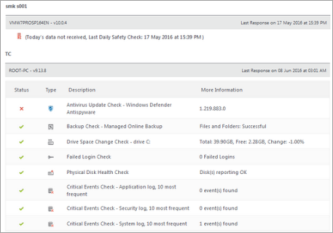
| Report Content | #CONTENT# | No | No | Yes | List of all the client'ssSites and their device status. |
|
| Report Content (Without Last Output) — Weekly report only | #CONTENTBASIC# | No | No | Yes | Same output to Report Content (#CONTENT#), but suppresses the results from when the Backup Check last ran. | |
| Date Generated | #DATE# | No | No | Yes | Date and time of report. | 10 Sep 2019 at 13:57:56PM
|
| Logo Image | #LOGO_IMG# | No | No | Yes | Logo image used in N-sight RMM and in reports. |
|
| Tagline Image | #TAG_IMG# | No | No | Yes | Tagline image used in N-sight RMM and report footers. |

|
Suppress Last Backup Check Result
An additional substitution string not available from the Insert Code drop-down is supported in the Server Weekly Report template. Entering #CONTENT_BACKUP_CHECK_BASIC# suppresses the results from when the Backup Check last ran.
In the Mail Template replace #CONTENT# with #CONTENT_BACKUP_CHECK_BASIC#
Resend Client Weekly Report
After you configure the Mail Template, you can test it to ensure the changes display as expected by resending the Client Weekly Report to a specified recipient.
- In the All Devices view, go to Reports > Client Reports > Server Monitoring > (Re)send Client Weekly Report.
- Select the Client from the drop-down list.
- Enter the recipient email address(es).
- Click OK to send the report to the recipient.
Multiple email recipients
You can separate multiple email addresses with commas or semicolons. Use only one type of delimiter in a list. Mixing commas and semicolons in the same list prevents email delivery.
Supported:
- you@example.it, me@example.it, everybody@example.it
- you@example.it; me@example.it; everybody@example.it
Unsupported:
- you@example.it, me@example.it; everybody@example.it
If the descriptive name in the From address contains a comma, enclose the name in quotation marks. This also applies when using wildcards.
- "Descriptive, name" <my@address.it> or "#ACCOUNT#" <my@address.it>
Use this option in conjunction with Check Clearing to send your Client a "No Problems Report".
SPF records and the allowed list
Changes to the template From address, for example to an email address from your domain, can cause the email to be classified as coming from a spoofed domain.
If you use Sender Policy Framework (SPF) and a custom From address for alerts and reports, we recommend that you Configure DNS Records for N-sight RMM email notifications.
If you use an email security firewall, we recommend that you allow the N-sight RMM mail server.
From Address Format
The All Devices view supports the use of commas as separators when you configure multiple email recipients. If the From address contains a descriptive name with a comma, or the possibility of a comma when using substitution strings, we recommend you encapsulate the name in inverted commas " ". For example:
- "Descriptive, name" <my@address.rmm>
- "#ACCOUNT#" <my@address.rmm>
- "#CLIENT#" <my@address.rmm>
If you use a custom From address in a mail template, make sure the address exists. If it does not exist, sender verification may fail. The default mail server for the From address is: alert@remote.management.